Water System Description
Livingston provides drinking water service to residential, commercial, industrial, and institutional customers within the city limits. The City's municipal water system extracts water from the underground aquifers via a series of groundwater wells distributed throughout the City. The City relies on groundwater to meet its supply needs. According to the 2005 Urban Water Management Plan, feasible alternative sources do not exist within or nearby the City of Livingston, so the City must rely on the underlying groundwater basin as an expanding source for future water supply.
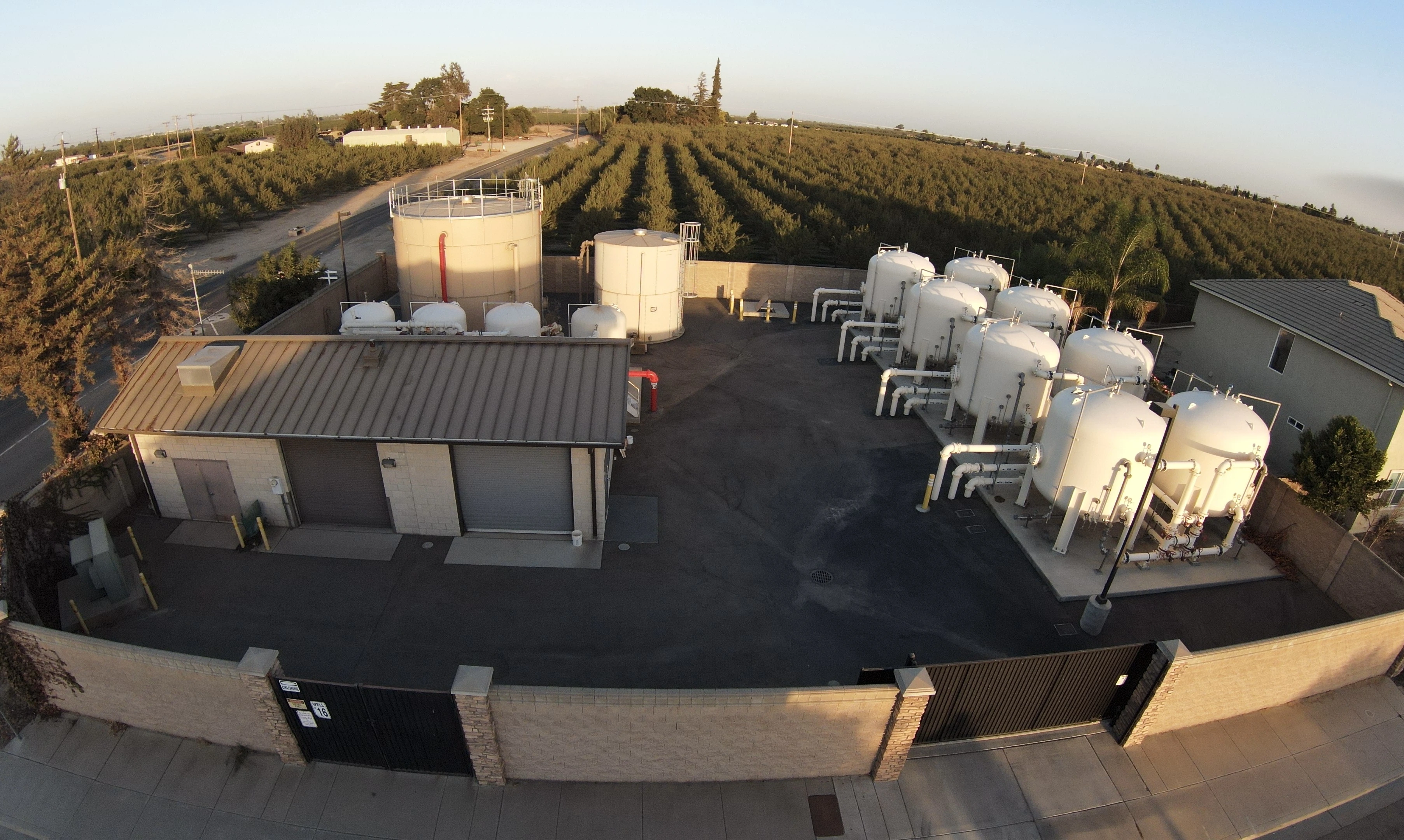
The City's water system facilities include eight active groundwater wells, a 1-million-gallon water storage tank, and over 36 miles of pressurized pipes ranging from two inches to 16 inches in diameter. The active wells have individual capacities ranging from 970 to 1,400 gallons per minute. In January 2008, these wells had a supply capacity of approximately 10.8 million gallons per day. The firm capacity (defined as the capacity with one of the largest wells out of service) was approximately 8.9 million gallons per day. In August 2008, integrating Well #16 into the system increased supply capacity by another 1.73 million gallons per day (mgd). Water storage balances the distribution system and helps meet fire-flow and emergency requirements. State regulations require the City to deliver water pressure of at least 20 pounds per square inch (psi); typically, the City's water pressure is 48 psi or better.
Water System Improvements
The City spent approximately $3.2 million during FY2008 to install 18,936 feet of new water line, of which $1,906,700 was paid for by a State Proposition 13 water grant. In addition to replacing aging water lines, the City has aggressively installed water meters to promote water conservation and ensure that all residential, commercial, and industrial customers are billed correctly for the water they use. Over a two-year period more than 1,600 water meters were installed, and today the City meters 97 percent of all its water accounts.
Beyond water meters, the City requires commercial, industrial, and multi-family residential customers and other users to install backflow prevention devices to protect the water system from contamination. Future water system improvements are guided by the City's Water Distribution System Master Plan, approved by the City Council in May 2008, which describes the current water system and lists future water system capital improvements.
Water Consumption
Historical water consumption and production show seasonal and yearly fluctuations. In 2005, the City produced over 2 billion gallons (5.6 million gallons per day, or 6,283 acre-feet) of water serving a population of approximately 14,321 residents. Over the past 10 years the consumption rate has ranged from a low of 423 gallons per capita per day in 2003 to 628 gallons per capita per day in 1999. Excluding industrial users, the per-capita consumption rates are considerably lower. The current Water Distribution System Master Plan uses 200 gallons per capita per day for planning purposes.
Water System Regulations
The Safe Drinking Water Act, enacted into law on December 16, 1974, is the main federal law that ensures the quality of Americans' drinking water by setting standards for drinking water quality and providing guidance to states, localities, and water suppliers who implement those standards. Drinking water quality is governed by Title 22 of the California Code of Regulations, which specifies the allowable maximum contaminant levels (MCL) for a wide range of primary and secondary water quality constituents. The City tests the drinking water for many constituents as required by State and Federal regulations and publishes the results each year in an annual Consumer Confidence Report (see below).
Water Service Rates
The document below shows the City's existing water rate structure.
Documents
Water Quality Notices
The City notifies customers when a water quality constituent exceeds a drinking water standard. In 2023, 1,2,3-trichloropropane (1,2,3-TCP) was detected above the drinking water standard; the first-quarter notice is provided below along with guidance on protecting water quality from urban runoff.
Documents
Proposition 13 Water Grant
A State Proposition 13 water grant helped fund $1,906,700 of the City's FY2008 water-line replacement work. The map below shows the improvements funded by the grant.
Documents
Consumer Confidence Reports
Each year the City publishes a Consumer Confidence Report summarizing drinking water quality test results. Reports from 2018 through 2025 are available below.
Documents
- Water Consumer Confidence Report 2018
- Water Consumer Confidence Report 2019
- Water Consumer Confidence Report 2020
- Water Consumer Confidence Report 2021
- Water Consumer Confidence Report 2022
- Water Consumer Confidence Report 2023
- Water Consumer Confidence Report 2024 (opens in a new tab)
- Water Consumer Confidence Report 2025
Urban Water Management Plans
The Urban Water Management Plan (UWMP) describes the City's water supply, demand, and long-term planning. The 2020 and 2025 plans are available below.